Welcome to Eat Well Every Day

Welcome to Eat Well Every Day!

I've spent years researching nutritional information, food ideas and recipes, because cooking and eating - especially with family & friends - are some of life's great pleasures. And guess what- healthy food doesn't have to be boring! It can be exciting and delicious!

Labels

vitamin C (11) antioxidants (9) calcium (8) garlic (8) winter (8) gluten-free (7) seasonal eating (7) protein (6) summer (6) cakes (5) iron (5) vegan (5) vegetarian (5) chocolate (4) cookies (4) flour (4) green vegetables (4) immune system (4) meat (4) pears (4) soups (4) vitamin A (4) B Vitamins (3) Mediterranean (3) almonds (3) beta-carotenes (3) casseroles (3) farmers' markets (3) fibre (3) fruits (3) ginger (3) lamb (3) lentils (3) limes (3) sustainability (3) Christmas (2) anaemia (2) apples (2) autumn (2) baking (2) beef (2) bones (2) broccoli (2) cancer (2) chickpea (2) cinnamon (2) dairy (2) feta (2) garbanzos (2) haemoglobin (2) mango (2) mushrooms (2) raspberries (2) stews (2) tomatoes (2) Australia Day (1) Indian cookery (1) Michael Pollan (1) Omega-3 (1) Omega-6 (1) amino acids (1) applesauce (1) beetroot (1) biscotti (1) biscuits (1) blood pressure (1) chicken (1) children (1) chilli (1) cloves (1) cocoa (1) coeliac disease (1) courgettes (1) dahl (1) diabetes (1) eggs (1) factory farming (1) figs (1) food combining (1) foraging (1) gardening (1) guerrilla gardeners (1) heritage vegetables (1) kidney beans (1) lactose-intolerant (1) leeks (1) lime juice (1) longevity (1) lycopene (1) marmalade (1) meatless meals (1) multi-coloured carrot (1) organic producers (1) parsley (1) prosciutto (1) pumpkin (1) red wine (1) rice (1) rye (1) salad (1) silverbeet (1) soy (1) spices (1) spinach (1) squash (1) street gardens (1) tainability (1) tapioca (1) teeth (1) tryptophan (1) whole foods (1) zucchini (1)
Showing posts with label iron. Show all posts

Sunday, July 1, 2012

Feeling Chilly? Have Some Chilli


You know it’s cold when you can see your breath, and for sunny Sydney, that time has arrived! It’s well and truly winter, with mid-winter festivals and Christmas in July all over the city and up in the Blue Mountains. Time for some hot food, really hot!

When most people think hot, in food terms, chilli (chili) is what springs to mind. We’ve all seen tv docos or YouTube clips of people trying to eat the hottest chilli peppers, and suffering for their courage! Are they mad?

It’s much easier to enjoy chilli’s heat in a good dish of chilli beans or chilli beef, or in a more subtle form in a good red curry. The heat in chillis comes from a phytonutrient called capsaicin, also found in capsicums (bell peppers), which may have anti-inflammatory effects, and is being researched for possible effects on tumours. It’s also rumoured to help you burn fat faster. Whatever the truth of these claims, capsaicin certainly warms you from the inside!

Cayenne pepper also contains capsaicin, and is a great garnish sprinkled on soups, scrambled eggs, toasted cheese, or added to a stew for a hint of fire.

So, to the recipes

Vegetarian Chilli Beans
I couldn’t do a post on chilli without giving the recipe for the best chilli bean dish I’ve tried, thanks to a friend of a friend in the US. The addition of oregano, cumin, fennel and cayenne give it a Cajun flavour. Since it’s an American recipe, I’ll give the American terms first, followed by the Aussie/English ones. If you leave off the cheese or sour cream, this is a totally vegetarian/vegan dish.

1 medium yellow (brown) onion, chopped
1 medium yellow or red bell pepper (capsicum) , diced
3 cloves garlic, pressed, crushed or chopped finely
1 teasp paprika
1 tablesp chili powder, or dried chili, or 1 tablesp sambal oeleck paste
1/2 teasp dried thyme
1/2 teasp dried oregano
1/2 teasp fennel seeds
1 teasp ground cumin
generous pinch or sprinkle of cayenne pepper
1x 15 ounce (425 gram) can kidney beans, drained and rinsed
1x 15 ounce (425 gram) can diced tomatoes
Salt and black pepper to taste
olive oil for sautéing

Sauté the onion and capsicum gently in the oil until soft but not browned. Toss in the beans garlic, chilli and spices, sir to coat with oil. Toss in the tomatoes, bring to the boil, cover and simmer gently for 15-20 minutes.
Adjust seasonings to taste and serve on rice, (white or brown), polenta, noodles, a baked potato – whatever carbohydrates you favour. Garnish with chopped cilantro (coriander) or flat leaf parsley, and you could also add a handful of tasty cheese. A dollop of sour cream goes nicely too!
Serves 2


Spicy Brown Rice and Bean Soup
Chilli heats up this minestrone-style soup, and turmeric deepens the flavour while adding extra iron.


2x 425 gram (15 ounce) can kidney beans, or any other beans or chickpeas (garbanzos), drained and rinsed
1x 425 gram (15 ounce) can of tomatoes
6 tablesp partially cooked brown rice
1 large onion, chopped
1 large carrot, sliced or cubed
2 sticks of celery, chopped
1 large potato, peeled and cubed (optional)
2 cloves of garlic, chopped (more if you like)
2 tablesp chilli powder, or dried chilli, or 1 tablesp sambal oeleck paste
1 tablesp turmeric powder
salt & pepper to taste
oil for sautéeing
1.5 litres (about 6 cups) stock or water and stock cubes

Sautee the vegetables , apart from garlic, in the oil, until onions start to soften, add the half-cooked rice. Tip in the turmeric and chilli and stir to release aromas and to coat the rice and vegetables. Add the garlic and tomatoes.

Pour in the stock, bring to the boil and simmer for 10-15 minutes , until rice is cooked. Add the beans and simmer gently for another 10 minutes, or until the soup smells and tastes right. Garnish in the same way as the chilli pot, and serve with crusty bread or thin toast

Variation: you could replace the potato with cubed pumpkin (winter squash), which goes really well with turmeric and chickpeas.
Serves 4

Buon Appetito!

Tuesday, August 16, 2011

Almonds and Pears

“Almonds and pears” – sounds like something out of an old nursery rhyme, or maybe some Cockney rhyming slang. But it isn’t either of those, it’s two ingredients that are cheap, plentiful and healthy, which combine together beautifully in many recipes, especially cakes and cookies.

I’ve told you about pears – ‘the gift of the gods’ and why pears are counted in the top 100 healthiest foods.

But what about almonds? The humble ‘nut’ (botanically, it’s a ‘drupe’ not a nut, but who’s counting?) of a tree related to peaches and apricots, with the most glorious blossom in early spring, the almond has been revered for thousands of years as a symbol of fertility and happiness. When you see the white froth of almond blossom, you know spring is just around the corner.

Believed to have originated in the North of Africa and western Asia, almonds are now grown in many countries with a Mediterranean climate, including Australia. Australia is the world’s third-largest producer of almonds, after California and Spain. No wonder we can always get fresh almonds relatively cheaply!

Almonds can be bought as plain raw nuts, roasted, blanched, blanched and slivered or flaked, or as almond meal. Because the Omega-3 and Omega-6 content can be damaged by high heat, it’s preferable to dry roast the nuts yourself, instead of buying commercially roasted almonds. Put them in a single layer on a baking tray and roast for about 20 minutes in a low oven (no higher than 100C or 212F).

Almonds’ high nutritional value

Because of their subtle flavour, almonds can combine with almost any other food But it’s not their versatility that includes them in the ‘healthiest foods’ – these nuts are actually given ‘qualified health claim’ status by the United States’ Food & Drug Administration in recognition of the health benefits of eating almonds every day.

For such a small item, an almond packs a mighty nutritional punch. As well as their high protein content, almonds have monounsaturated fat, Omega-3 and Omega-6 fatty acids, fibre, and as much calcium as cow’s milk, along with good amounts of Vitamins A, C, E and D, all the B vitamins, folate and Vitamin K. Then there's the minerals: copper, iron, magnesium, manganese, phosphorus, potassium and zinc.

So, to the recipes: Pear and Almond Cake

Almonds combine beautifully with pears in this cake, which can double as dessert, warmed slightly and served with cream, icecream or yoghurt. Or you can toast slices and spread with soft butter.

2 cups sugar
3 cups pears, peeled and diced,
2 cups plain (all purpose) flour and baking powder to raise,
1 teasp bicarb (baking soda)
1 teasp salt
2 teasp cinnamon
3 eggs, beaten
1 cup oil or melted butter
2 teasp vanilla essence
1 cup slivered almonds

Mix together the pear pieces and sugar and leave for 20 minutes or so to develop juices.

Sift together the flour, salt, cinnamon and raising agents, then add rest of the ingredients and stir well. Bake in a greased large square tin or a Bundt pan at 180C (350 F) for 1 hour.

Ginger and Almond Cookies

Remember to make the dough well ahead of when you want these cookies, as it has to sit in the fridge for several hours to firm up before baking.

¾ cup (190 g/6 ounces) of softened butter
1 cup packed, soft brown sugar
2 tablesp light molasses, honey or Golden Syrup
1 egg
1½ teasp baking powder
½ teasp salt
1 teasp fresh ginger, grated finely, or at least 1 teasp ground ginger (more if you prefer)
1¼ cup plain (all purpose) flour
1 cup ground almonds (almond meal)
48 blanched whole almonds (cheaper to blanch your own.)

In a large bowl, cream the butter and brown sugar until light and fluffy. Beat in molasses/honey/Golden Syrup, the egg and ginger. Sift together the flour, baking powder and salt, then mix into sugar and butter mixture until you have a soft dough.

Form the dough into two logs, wrap in plastic wrap and refrigerate several hours or overnight. Meanwhile, blanch your almonds, if you haven’t bought ready blanched ones. Put them in a heatproof bowl, pour hot, (not quite boiling) water over them and leave to cool, when you can slip the skins off.

Cut the dough in slices and shape these into walnut sized balls. Put about 2" apart on a greased cookie sheet, and press a blanched almond into centre of each ball, flattening them slightly. Bake for 10 to 15 minutes in a 175C (350F) oven until lightly browned on bottom.

Makes about 4 dozen.

Buon Appetito!

Tuesday, August 2, 2011

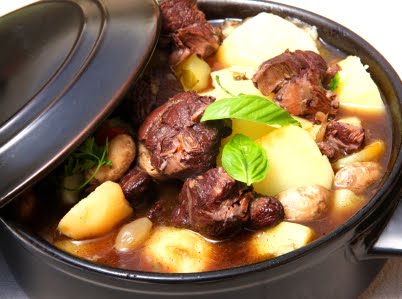
Hearty Winter Casseroles - Boeuf Bourgignon

August has just begun and at last we’re on the downhill run to Spring. But it is still winter, and August is the month when the old saying “as the days grow longer, the cold grows stronger” holds true. So, despite sunny days in Sydney that can reach 21C at midday, there are still chilly nights and gloomy grey days, (especially in Melbourne and Tasmania), and that means warming winter stews.

Stews and casseroles are interchangeable terms. Technically, a casserole is cooked in a casserole dish in the oven, while a stew simmers gently on the top of the stove. But really, they are interchangeable, the main point to remember is to cook slowly and gently. You can use a crockpot or slow cooker, a casserole or a stewpot, but DO NOT use a pressure cooker! Pressure cooking a stew results in tough meat and bland flavours and is a waste of good ingredients.

In an earlier post I wrote in praise of meat as a treat, not as something to be had every day. In that post, I talked about lamb – my favourite meat, and one of the world’s 100 healthiest foods.

So this time I’m focusing on beef – actually stewing steak and gravy beef, (sorry, I don’t know the equivalent US term). Australia is fortunate to have high quality meat that is relatively inexpensive, and stewing steak and the slightly fattier gravy beef are budget pleasing cuts. They are cheap, incredibly nourishing, and respond best to slow, gentle cooking, melting into tenderness and creating rich flavours with the other ingredients.

What’s so good about beef?

• High quality protein with all the essential amino acids in one package in relatively large amounts. One hundred grams of beef contains approximately 33 grams of protein.
• Iron, specifically haem iron, the easiest one to absorb. Iron is so essential for avoiding anaemia, and for enabling the blood's red cells to carry oxygen around the body. That 100 grams provides a hefty three to four milligrams of iron.
• Vitamins B1, B2, B6 and B12, zinc, selenium and phosphorus – good amounts of these essential vitamins and minerals.
• Tryptophan, the “feel good” food element. Tryptophan is an amino acid that works as a precursor to serotonin, the neurotransmitter that regulates sleep, appetite and mood. Foods rich in tryptophan are said to be “good mood foods”. Beef has tryptophan in spades – 100 grams contains about 0.33 grams.

So to the recipe: Boeuf Bourgignon

This is not the upmarket version that Guillaume Brahimi prepares, but a more budget conscious, down-to-earth casserole that’s probably nearer the French peasant original. As the name suggests, the meat was originally cooked in Burgundy. Since appellation contrôlée, we can no longer buy Burgundy in Australia, so choose a hearty red wine such as a cabernet-merlot or cabernet shiraz blend. Even a good cask wine will serve the purpose.

1kg (2 lb) stewing steak cut into 4cm (1½ inch) cubes
125 gm (4 oz) streaky bacon, cut into strips
1 carrot, sliced
1 onion, chopped
1 (or more) garlic clove smashed or chopped
1 teasp salt and ¼teasp ground black pepper
1 tablesp plain flour
500 ml (2 cups) red wine
250 ml (1 cup) beef stock (or chicken stock)
2 tablesp tomato puree
½ tsp thyme
1 bay leaf

16 small button onions or shallots peeled
60 gm (2 oz) butter
2 tablesp olive oil
375 gm (12 oz) button mushrooms

Put the flour with the salt and pepper into a large paper or plastic bag, and shake gently to mix. Drop in the beef cubes, a few at a time and shake to coat the meat with seasoned flour. Keep the bag firmly closed as you shake, you don’t want flour flying all over the kitchen and you!

If your casserole is safe to use on the stovetop, fry the bacon strips in it until the fat is rendered out and the pieces are crisp. Use a large frying pan if you can’t fry with the casserole. (The frying pan needs to be big enough to hold the meat, vegetables, stock and wine.) Take out the bacon, leaving the fat in the pan.

Add a big slurp of oil and heat until sizzling, throw in the meat cubes in batches so as not to crowd them, and brown all over. Set aside with the bacon. Now add the carrot and chopped onion and fry briefly.

Put the bacon and meat back into the casserole/frying pan, add the tomato puree, thyme, bay leaf and garlic, then pour in the red wine and stock. Bring the mixture to a rolling boil, stirring as it boils, and turn down to a low simmer. Allow it to simmer gently for five minutes to cook off all the alcohol, then transfer casserole to a preheated 160C (325F) oven. Cook for 3 to 4 hours.

Meanwhile, prepare the mushrooms and shallots. Heat up half the butter & olive oil in a small saucepan and sauté the onions or shallots for about 10 minutes until softened and brown. Set aside and repeat with rest of the butter and oil and the button mushrooms.

When the meat is tender, pour off as much of the liquid as you can from the casserole into a saucepan. Pop the cooked onions/shallots and mushrooms into the casserole, tucking them in around the meat. Bring the cooking juices to a boil, and simmer until reduced to about a third. Pour back into the casserole.

Serve with potatoes, either steamed or mashed and creamy, and steamed green vegetables.
Serves 4.

Another Beef Casserole in the next post!

Buon Appetito!

Friday, September 10, 2010

Mmmarvelous mushrooms!

It’s early Spring here in Australia and so, naturally, we’re enjoying a return to winter with cold grey days, rain and gusty winds. Thank goodness, another winter specialty is hanging around – mushrooms. Especially the big flat meaty ones. These are just the final maturing of the little white cap mushrooms grown commercially, but they have by far he best flavour, rich, dark, strong, and work equally well with beef or lamb in hearty winter stews or as a dish in their own right.

As well as the commonly available button mushrooms in all stages from tightly closed to the wide open ‘flat mushrooms’, mushroom lovers can enjoy portobellos, swiss brown, oyster, shiitake, enoki, chestnut, crimini and other exotic varieties, as well as the highly prized and hugely expensive truffle. Regardless of the variety, all mushrooms contain health giving vitamins and minerals along with their tempting flavours.

What’s good about mushrooms? Antioxidants!

Mushrooms are a surprising source of antioxidants. Eating mushrooms regularly can boost your immune system and these fungi have even been credited by some researchers as helping to fight cancers, thanks to their high antioxidant content. Japanese mushrooms are also believed to help lower blood pressure.

The specific antioxidant in mushrooms is L-ergothioneine, also found in wheatgerm and chicken livers. Mushrooms have about 12 times as much L-ergothioneine as wheat germ and four times more than chicken liver. What’s more, this powerful antioxidant is not destroyed when mushrooms are cooked.

Mushrooms also contain valuable amounts of the mineral selenium. Working together with vitamin E, selenium ensures the proper functioning of numerous vital antioxidant systems throughout the body.

Selenium’s antioxidant activity is helpful in protecting colon cells from cancer-causing toxins, and is also credited with decreasing asthma and arthritis symptoms and in the prevention of heart disease. In addition, selenium is involved in DNA repair, associated with a reduced risk for cancer.

B vitamins, valuable minerals and protein


All mushrooms are an excellent source of riboflavin (vitamin B2), niacin (vitamin B3), pantothenic acid (vitamin B5), as well as the minerals selenium, copper, zinc, iron, manganese, potassium and phosphorus. Mushrooms’ B vitamin content is a boost for vegans who, as a result of a restricted diet compared to vegetarians and omnivores, often struggle getting enough of these vitamins.

Both iron and copper are necessary for the body to synthesis haemoglobin to carry oxygen around in the blood. These two minerals are also quite difficult for non-meat eaters to get enough of, so mushrooms are a valuable addition to vegan or vegetarian meals

While mushrooms are not particularly high in protein at around 3 per cent by weight, they combine well with other animal and vegetable proteins to increase the total protein intake.

Cheap mushrooms as good as expensive varieties

While the World’s 100 Healthiest Foods lists exotic mushrooms such as crimini and shiitake, French food chemists at the Institut National de la Recherche Agrinomique have shown that ordinary commercial button mushrooms have as much or even more anti-oxidant activity as more expensive varieties.

Lead researcher and co-author of the paper published in the Journal of the Science of Food and Agriculture, Dr. Jean-Michel Savoie commented: "It can be reasonably assumed that white button mushrooms have as much, if not more, radical scavenging power as mushrooms currently touted for their health benefit. The good thing is button mushrooms are available all year round, are cheap and may be an excellent source of nutrition as part of a healthy diet."

Not only that, you can even buy mushroom kits and grow your own!

mushroom makingsSo, to the recipes. As mushrooms have a place in both omnivore and non-meat eating diets, I’m offering both options – a basic cream of mushroom soup and an easy baked fish and mushrooms.

Cream of Mushroom Soup

60g butter or 2 tablespoons olive oil
1 red onion, finely chopped
2 garlic cloves, crushed
600 grams (about 20 ounces) of cap mushrooms, sliced
about 5 tablesp of plain (all purpose) flour
1.25 litre (5 cups) vegetable stock (or water plus 2 stock cubes)
1/2 cup light cream* OR 1 egg beaten up in 1/4 cup of milk*
about 5 tablesp of chopped fresh flat-leaf parsley
salt & ground black pepper

Heat the butter or oil in a large heavy saucepan over medium-high. Add the onion and garlic and cook, stirring often, for three or four minutes or until soft. Then add the chopped mushrooms and cook, stirring occasionally, for 10 minutes or so until the mushrooms are tender. Remove 1/4 cup of mushrooms and set aside.

Add the flour to remaining mushrooms and cook, stirring for two minutes. Gradually add the stock, stirring constantly until all the stock has been added and bring to the boil. Lower the heat to simmering and cook the soup, uncovered, for about 10 minutes, stirring occasionally.

Remove from the heat, and blend in a food processor or with a stick blender until smooth. Return to the saucepan over low heat. Stir in the cream* and parsley. Heat over medium-low heat until slightly thickened.

Season with salt and pepper, ladle into bowls and serve topped with reserved mushrooms and more parsley, if liked. Serves 4 as a starter.

*Vegans: I’m sorry, you’ll have to work out how to substitute the cream.

Baked Fish and Mushrooms

4 fresh or frozen fish fillets (about 500 grams or a pound), ½ to ¾ inch thick
2 tablesp butter or oil
1 ½ cups sliced fresh mushrooms
2 small or one large onion, sliced
1 teasp snipped fresh tarragon or thyme, (or ¼ teaspoon dried tarragon or thyme, crushed)
juice of ½ small lemon

Thaw fish, if frozen. Rinse and pat dry with paper towels. Cut into serving-size pieces, if necessary and arrange in a rectangular baking dish, turning under thin edges, so all pieces are approximately the same thickness. Sprinkle with salt.

In a small saucepan melt butter or oil; add the mushrooms, sliced onions, and dried herbs, if using. Cook over medium heat until mushrooms and onions are tender.

Spread mushroom mixture evenly over fish pieces and sprinkle with any fresh herbs. Squeeze over a little lemon juice. Cover with foil or a lid and bake in a hot oven (220C, 450F) for between 12-18 minutes, or until fish flakes easily with a fork.

Sprinkle more lemon juice and more fresh herbs if you have them, and serve with steamed buttered vegetables. Serves 4

Buon Appetito!

Monday, April 26, 2010

Ironing out Anaemia

Every body needs dietary iron to build healthy red blood cells and mitochondria (‘cellular power plants') producing energy.

Iron is vital for producing healthy red blood cells (erythrocytes) which help carry oxygen around the body. As well as haemoglobin, iron is needed for myoglobin, another oxygen-carrying molecule, which distributes oxygen to muscles cells, especially to skeletal muscles and to the heart.

It also helps keep the immune system strong and helps the body produce energy from the foods eaten, through chemical reactions from enzymes produced via the mitochondria.

Too little iron and you can become anaemic, lethargic, susceptible to infections, dizziness and headaches. Really low levels of iron can make you unable to concentrate and can contribute to depression.

Women Need More Iron than Men

Women between the stages of puberty and menopause need higher levels of iron than men of equivalent age, to replace the iron lost through menstrual blood. Pregnant women can be at risk of anaemia if they don’t watch their iron levels, as the developing foetus draws on the mother’s iron for its developmental needs. Breast feeding mothers also need to increase their iron intake.

People who donate blood regularly, elderly people, vegetarians, and children are often unaware of being low in dietary iron. Young children, especially, need adequate iron levels as their rapidly growing bodies consume iron to build muscle and blood cells.

Men, on the other hand, as they don’t lose blood each month, bear children or lactate, are at risk of having too much iron. Chronic iron overload, or excessive iron storage, can cause loss of appetite, fatigue, weight loss, headaches, bronze or grey hue to the skin, dizziness, nausea, and shortness of breath. Too much iron has been suggested as a factor in heart disease, cancer and rheumatoid arthritis.

Which Iron Do You Eat?

There are two sorts of iron the body can absorb and use – haem iron and non-haem iron. Haem iron is found only in meat, as it is derived from the haemoglobin and myoglobin in animal tissues. Non-haem iron is found in plant foods and dairy products.

Vegetarians and vegans will be dependent on non-haem iron for all their dietary iron, so it’s important to eat as wide a range of foods as possible to maximise iron intake.

Good Sources of Iron

Excellent food sources of iron include chard (our green friend, silverbeet), spinach, thyme, and, surprisingly, turmeric. A good reason to eat lots of golden curries.

Very good sources include parsley, romaine lettuce, blackstrap molasses, tofu, mustard greens, turnip greens, string beans and shiitake mushrooms.

Good sources of iron include beef, lamb, offal (liver, kidneys, heart), lentils, cocoa powder, eggs, Brussels sprouts, asparagus, venison, garbanzo beans, broccoli, leeks and kelp.

Be aware that cooking with iron cookware will add iron to food, so for men, watch out for iron toxicity from that steak sizzling on the hot iron plate!

Vitamin C and Non-haem Iron

Non-haem iron is harder for the body to absorb than haem iron. A combination of haem and non-haem iron in the same meal – eg red meat and green vegetables – makes the non-haem iron more easily absorbed.

However, vegetarians and vegans are dependent entirely on non-haem iron, so as well as eating a wide choice of foods, they should make sure they have adequate Vitamin C and copper in the meal to maximise their iron absorption.

Vitamin C is easy – just add tomatoes, orange slices or capsicum (bell peppers) to a salad, or a squirt of fresh lemon juice over steamed green vegetables.

Copper and Iron

Copper assists the body to metabolise iron to create haemoglobin and myoglobin. Unfortunately, it is another of those minerals that many people are likely to be low on, and some sources suggest that anaemia is actually the result of a copper deficiency.

However, there is no indication that cooking with a copper pan, like my favourite omelette pan, will add copper to the diet!

The best sources of dietary copper other than seafood and offal are nuts, yeast, bran and cocoa powder.

So, to the recipes. As the weather is heading through autumn to winter here in Australia, I’m going for home cooking of distinctly British origin – an old-fashioned lamb chop stew, known as Lancashire Hotpot, and a chocolate self-saucing pudding.

Lancashire HotpotLancashire Hotpot

1kg (2 pounds) of lamb cutlets
2 lamb kidneys, peeled, cored and sliced
4 medium onions, sliced
250 grams (1/2 a pound) of mushrooms, sliced
750 grams (1 & ½ pounds) potatoes, scrubbed & sliced thin
1 tablesp flour, seasoned with salt & pepper
500 ml (3/4 pint) of stock, or warm water plus 2 stock cubes or Worcester Sauce

Trim any fat off the chops and coat them and the kidney slices in seasoned flour. Place layers of meat, onions, kidneys, mushrooms and potatoes in a large casserole, finishing with a layer of potatoes.

Pour over the stock, and bake, covered in a moderate oven (180C, 350F) for two hours. Remove the lid and cook for another half hour to brown the potato topping.

Serve with carrots or pumpkin and a green vegetables such as beans, Brussels sprouts, broccoli or spinach. Sprinkle servings with chopped parsley for extra Vitamin C and iron.

Serves 4

Self-Saucing Chocolate Fruit Pudding

This would be a great winter pud to have after the Lancashire Hotpot – real comfort food. It would also be a nice treat after a vegetarian meal such as rice and dhal, although vegans would need to make some changes to this recipe. Both the cocoa powder and the dried fruit provide iron, and cocoa contributes copper and antioxidants.

½ cup milk
60 grams (2 ounces) butter or margarine
¾ cup caster sugar
1 teasp vanilla essence
1 cup self-raising flour, or plain (all purpose flour) and baking powder
¼ cup dried fruit – sultanas, currants or mixed dried fruit
1 tablesp cocoa powder
¾ cup brown sugar
2 cups boiling water
1 extra tablesp cocoa

Sift together flour (baking powder), cocoa and caster sugar. Stir in dried fruit to coat fruit completely.

In a small saucepan or a glass jug in the microwave, melt together the butter and milk, stir in the vanilla essence.

Combine the liquids and the flour mixture until just mixed and pour into a greased 6-cup casserole dish.

Sift the extra cocoa and brown sugar over the pudding. Slowly pour the boiling water over the mixture.

Bake in moderate oven (180C, 350F) for 30-40 minutes, until a skewer in the centre comes out clean (apart from the sauce).

Serves 6 (or 4 with left-overs for breakfast).

Buon Appetito!