Welcome to Eat Well Every Day

Welcome to Eat Well Every Day!

I've spent years researching nutritional information, food ideas and recipes, because cooking and eating - especially with family & friends - are some of life's great pleasures. And guess what- healthy food doesn't have to be boring! It can be exciting and delicious!

Labels

vitamin C (11) antioxidants (9) calcium (8) garlic (8) winter (8) gluten-free (7) seasonal eating (7) protein (6) summer (6) cakes (5) iron (5) vegan (5) vegetarian (5) chocolate (4) cookies (4) flour (4) green vegetables (4) immune system (4) meat (4) pears (4) soups (4) vitamin A (4) B Vitamins (3) Mediterranean (3) almonds (3) beta-carotenes (3) casseroles (3) farmers' markets (3) fibre (3) fruits (3) ginger (3) lamb (3) lentils (3) limes (3) sustainability (3) Christmas (2) anaemia (2) apples (2) autumn (2) baking (2) beef (2) bones (2) broccoli (2) cancer (2) chickpea (2) cinnamon (2) dairy (2) feta (2) garbanzos (2) haemoglobin (2) mango (2) mushrooms (2) raspberries (2) stews (2) tomatoes (2) Australia Day (1) Indian cookery (1) Michael Pollan (1) Omega-3 (1) Omega-6 (1) amino acids (1) applesauce (1) beetroot (1) biscotti (1) biscuits (1) blood pressure (1) chicken (1) children (1) chilli (1) cloves (1) cocoa (1) coeliac disease (1) courgettes (1) dahl (1) diabetes (1) eggs (1) factory farming (1) figs (1) food combining (1) foraging (1) gardening (1) guerrilla gardeners (1) heritage vegetables (1) kidney beans (1) lactose-intolerant (1) leeks (1) lime juice (1) longevity (1) lycopene (1) marmalade (1) meatless meals (1) multi-coloured carrot (1) organic producers (1) parsley (1) prosciutto (1) pumpkin (1) red wine (1) rice (1) rye (1) salad (1) silverbeet (1) soy (1) spices (1) spinach (1) squash (1) street gardens (1) tainability (1) tapioca (1) teeth (1) tryptophan (1) whole foods (1) zucchini (1)
Showing posts with label meat. Show all posts

Thursday, August 4, 2011

More Hearty Winter Casseroles – Goulash

This is another of my old favourites from the 1970s. Cooked slowly in the oven for three or four hours, it transforms stewing steak or gravy beef into a savoury, slightly spicy – and in the 70s, distinctly exotic – dish redolent of paprika, tomatoes and caraway seeds. There's a potato topping to this casserole, or you can add dumplings instead to make a really filling dish

A Hungarian friend has since told me this is not an authentic goulash, so I haven’t called it Hungarian Goulash, as the 70s recipe did!

500 gm (1lb) stewing steak, cut into 4cm (1½ inch) cubes
500 gm (1lb) potatoes, sliced thinly
400 gm (12 oz) canned tomatoes & their juice
2 large onions, chopped
2 cloves garlic, minced or smashed
slurp of oil for sautéing
1 tablesp paprika, sweet or hot, (or a mixture, depending how hot you want the goulash)
1 tablesp marjoram (or oregano if no marjoram)
1 tablesp caraway seeds
1 teasp sugar
Hot stock, about 2 cups – you may not need all of this

Heat the oil in a large frying pan and sauté the onions and garlic until the onions are soft but not browned. Remove to the casserole. Turn up the heat and brown the beef cubes briskly all over. Sprinkle with the herbs and spices and add to the casserole.

Pour the tinned tomatoes and their juices into the frying pan and stir briskly to pick up any bits of meat or onion left behind. Add sugar to balance the tomatoes’ acidity, and pour into the casserole. Stir the mixture together. Add the hot stock, gently, a little at a time, until the meat is just covered with liquid.

Cover the casserole and cook at 160C (325F) for an hour and a half. Lower the temperature to 150C (300F) and cook for another hour and a half. While the casserole is cooking, make the dumplings, which you will add before the last 30 minutes of cooking.

If you’re not doing dumplings, layer the potato slices carefully over the top of the meat, pouring a little more hot stock over them to moisten them. Leave the lid off the dish and cook for the last 30 minutes or until the potatoes are soft and slightly crispy.

For the dumplings:
60 gm (2 ounces) self-raising flour or plain (all-purpose) flour and ½ teasp baking powder
a 250 gm packet of suet mix
Water, about ¼ cup to mix

Mix ingredients to a stiff dough. Divide into 8 and roll into small balls. Add these to the casserole when there is still 30 minutes of cooking to go, burying them in the stock. You may need to add a little more stock if the dumplings aren’t covered.

Serve with steamed and buttered carrots and cabbage. Serves 4.

Buon Appetito!

Tuesday, August 2, 2011

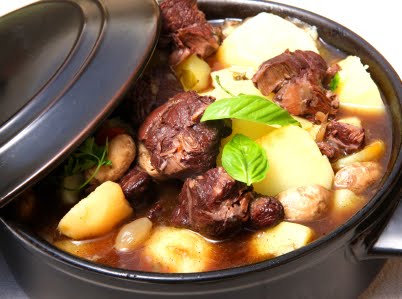
Hearty Winter Casseroles - Boeuf Bourgignon

August has just begun and at last we’re on the downhill run to Spring. But it is still winter, and August is the month when the old saying “as the days grow longer, the cold grows stronger” holds true. So, despite sunny days in Sydney that can reach 21C at midday, there are still chilly nights and gloomy grey days, (especially in Melbourne and Tasmania), and that means warming winter stews.

Stews and casseroles are interchangeable terms. Technically, a casserole is cooked in a casserole dish in the oven, while a stew simmers gently on the top of the stove. But really, they are interchangeable, the main point to remember is to cook slowly and gently. You can use a crockpot or slow cooker, a casserole or a stewpot, but DO NOT use a pressure cooker! Pressure cooking a stew results in tough meat and bland flavours and is a waste of good ingredients.

In an earlier post I wrote in praise of meat as a treat, not as something to be had every day. In that post, I talked about lamb – my favourite meat, and one of the world’s 100 healthiest foods.

So this time I’m focusing on beef – actually stewing steak and gravy beef, (sorry, I don’t know the equivalent US term). Australia is fortunate to have high quality meat that is relatively inexpensive, and stewing steak and the slightly fattier gravy beef are budget pleasing cuts. They are cheap, incredibly nourishing, and respond best to slow, gentle cooking, melting into tenderness and creating rich flavours with the other ingredients.

What’s so good about beef?

• High quality protein with all the essential amino acids in one package in relatively large amounts. One hundred grams of beef contains approximately 33 grams of protein.
• Iron, specifically haem iron, the easiest one to absorb. Iron is so essential for avoiding anaemia, and for enabling the blood's red cells to carry oxygen around the body. That 100 grams provides a hefty three to four milligrams of iron.
• Vitamins B1, B2, B6 and B12, zinc, selenium and phosphorus – good amounts of these essential vitamins and minerals.
• Tryptophan, the “feel good” food element. Tryptophan is an amino acid that works as a precursor to serotonin, the neurotransmitter that regulates sleep, appetite and mood. Foods rich in tryptophan are said to be “good mood foods”. Beef has tryptophan in spades – 100 grams contains about 0.33 grams.

So to the recipe: Boeuf Bourgignon

This is not the upmarket version that Guillaume Brahimi prepares, but a more budget conscious, down-to-earth casserole that’s probably nearer the French peasant original. As the name suggests, the meat was originally cooked in Burgundy. Since appellation contrôlée, we can no longer buy Burgundy in Australia, so choose a hearty red wine such as a cabernet-merlot or cabernet shiraz blend. Even a good cask wine will serve the purpose.

1kg (2 lb) stewing steak cut into 4cm (1½ inch) cubes
125 gm (4 oz) streaky bacon, cut into strips
1 carrot, sliced
1 onion, chopped
1 (or more) garlic clove smashed or chopped
1 teasp salt and ¼teasp ground black pepper
1 tablesp plain flour
500 ml (2 cups) red wine
250 ml (1 cup) beef stock (or chicken stock)
2 tablesp tomato puree
½ tsp thyme
1 bay leaf

16 small button onions or shallots peeled
60 gm (2 oz) butter
2 tablesp olive oil
375 gm (12 oz) button mushrooms

Put the flour with the salt and pepper into a large paper or plastic bag, and shake gently to mix. Drop in the beef cubes, a few at a time and shake to coat the meat with seasoned flour. Keep the bag firmly closed as you shake, you don’t want flour flying all over the kitchen and you!

If your casserole is safe to use on the stovetop, fry the bacon strips in it until the fat is rendered out and the pieces are crisp. Use a large frying pan if you can’t fry with the casserole. (The frying pan needs to be big enough to hold the meat, vegetables, stock and wine.) Take out the bacon, leaving the fat in the pan.

Add a big slurp of oil and heat until sizzling, throw in the meat cubes in batches so as not to crowd them, and brown all over. Set aside with the bacon. Now add the carrot and chopped onion and fry briefly.

Put the bacon and meat back into the casserole/frying pan, add the tomato puree, thyme, bay leaf and garlic, then pour in the red wine and stock. Bring the mixture to a rolling boil, stirring as it boils, and turn down to a low simmer. Allow it to simmer gently for five minutes to cook off all the alcohol, then transfer casserole to a preheated 160C (325F) oven. Cook for 3 to 4 hours.

Meanwhile, prepare the mushrooms and shallots. Heat up half the butter & olive oil in a small saucepan and sauté the onions or shallots for about 10 minutes until softened and brown. Set aside and repeat with rest of the butter and oil and the button mushrooms.

When the meat is tender, pour off as much of the liquid as you can from the casserole into a saucepan. Pop the cooked onions/shallots and mushrooms into the casserole, tucking them in around the meat. Bring the cooking juices to a boil, and simmer until reduced to about a third. Pour back into the casserole.

Serve with potatoes, either steamed or mashed and creamy, and steamed green vegetables.
Serves 4.

Another Beef Casserole in the next post!

Buon Appetito!

Monday, April 26, 2010

Ironing out Anaemia

Every body needs dietary iron to build healthy red blood cells and mitochondria (‘cellular power plants') producing energy.

Iron is vital for producing healthy red blood cells (erythrocytes) which help carry oxygen around the body. As well as haemoglobin, iron is needed for myoglobin, another oxygen-carrying molecule, which distributes oxygen to muscles cells, especially to skeletal muscles and to the heart.

It also helps keep the immune system strong and helps the body produce energy from the foods eaten, through chemical reactions from enzymes produced via the mitochondria.

Too little iron and you can become anaemic, lethargic, susceptible to infections, dizziness and headaches. Really low levels of iron can make you unable to concentrate and can contribute to depression.

Women Need More Iron than Men

Women between the stages of puberty and menopause need higher levels of iron than men of equivalent age, to replace the iron lost through menstrual blood. Pregnant women can be at risk of anaemia if they don’t watch their iron levels, as the developing foetus draws on the mother’s iron for its developmental needs. Breast feeding mothers also need to increase their iron intake.

People who donate blood regularly, elderly people, vegetarians, and children are often unaware of being low in dietary iron. Young children, especially, need adequate iron levels as their rapidly growing bodies consume iron to build muscle and blood cells.

Men, on the other hand, as they don’t lose blood each month, bear children or lactate, are at risk of having too much iron. Chronic iron overload, or excessive iron storage, can cause loss of appetite, fatigue, weight loss, headaches, bronze or grey hue to the skin, dizziness, nausea, and shortness of breath. Too much iron has been suggested as a factor in heart disease, cancer and rheumatoid arthritis.

Which Iron Do You Eat?

There are two sorts of iron the body can absorb and use – haem iron and non-haem iron. Haem iron is found only in meat, as it is derived from the haemoglobin and myoglobin in animal tissues. Non-haem iron is found in plant foods and dairy products.

Vegetarians and vegans will be dependent on non-haem iron for all their dietary iron, so it’s important to eat as wide a range of foods as possible to maximise iron intake.

Good Sources of Iron

Excellent food sources of iron include chard (our green friend, silverbeet), spinach, thyme, and, surprisingly, turmeric. A good reason to eat lots of golden curries.

Very good sources include parsley, romaine lettuce, blackstrap molasses, tofu, mustard greens, turnip greens, string beans and shiitake mushrooms.

Good sources of iron include beef, lamb, offal (liver, kidneys, heart), lentils, cocoa powder, eggs, Brussels sprouts, asparagus, venison, garbanzo beans, broccoli, leeks and kelp.

Be aware that cooking with iron cookware will add iron to food, so for men, watch out for iron toxicity from that steak sizzling on the hot iron plate!

Vitamin C and Non-haem Iron

Non-haem iron is harder for the body to absorb than haem iron. A combination of haem and non-haem iron in the same meal – eg red meat and green vegetables – makes the non-haem iron more easily absorbed.

However, vegetarians and vegans are dependent entirely on non-haem iron, so as well as eating a wide choice of foods, they should make sure they have adequate Vitamin C and copper in the meal to maximise their iron absorption.

Vitamin C is easy – just add tomatoes, orange slices or capsicum (bell peppers) to a salad, or a squirt of fresh lemon juice over steamed green vegetables.

Copper and Iron

Copper assists the body to metabolise iron to create haemoglobin and myoglobin. Unfortunately, it is another of those minerals that many people are likely to be low on, and some sources suggest that anaemia is actually the result of a copper deficiency.

However, there is no indication that cooking with a copper pan, like my favourite omelette pan, will add copper to the diet!

The best sources of dietary copper other than seafood and offal are nuts, yeast, bran and cocoa powder.

So, to the recipes. As the weather is heading through autumn to winter here in Australia, I’m going for home cooking of distinctly British origin – an old-fashioned lamb chop stew, known as Lancashire Hotpot, and a chocolate self-saucing pudding.

Lancashire HotpotLancashire Hotpot

1kg (2 pounds) of lamb cutlets
2 lamb kidneys, peeled, cored and sliced
4 medium onions, sliced
250 grams (1/2 a pound) of mushrooms, sliced
750 grams (1 & ½ pounds) potatoes, scrubbed & sliced thin
1 tablesp flour, seasoned with salt & pepper
500 ml (3/4 pint) of stock, or warm water plus 2 stock cubes or Worcester Sauce

Trim any fat off the chops and coat them and the kidney slices in seasoned flour. Place layers of meat, onions, kidneys, mushrooms and potatoes in a large casserole, finishing with a layer of potatoes.

Pour over the stock, and bake, covered in a moderate oven (180C, 350F) for two hours. Remove the lid and cook for another half hour to brown the potato topping.

Serve with carrots or pumpkin and a green vegetables such as beans, Brussels sprouts, broccoli or spinach. Sprinkle servings with chopped parsley for extra Vitamin C and iron.

Serves 4

Self-Saucing Chocolate Fruit Pudding

This would be a great winter pud to have after the Lancashire Hotpot – real comfort food. It would also be a nice treat after a vegetarian meal such as rice and dhal, although vegans would need to make some changes to this recipe. Both the cocoa powder and the dried fruit provide iron, and cocoa contributes copper and antioxidants.

½ cup milk
60 grams (2 ounces) butter or margarine
¾ cup caster sugar
1 teasp vanilla essence
1 cup self-raising flour, or plain (all purpose flour) and baking powder
¼ cup dried fruit – sultanas, currants or mixed dried fruit
1 tablesp cocoa powder
¾ cup brown sugar
2 cups boiling water
1 extra tablesp cocoa

Sift together flour (baking powder), cocoa and caster sugar. Stir in dried fruit to coat fruit completely.

In a small saucepan or a glass jug in the microwave, melt together the butter and milk, stir in the vanilla essence.

Combine the liquids and the flour mixture until just mixed and pour into a greased 6-cup casserole dish.

Sift the extra cocoa and brown sugar over the pudding. Slowly pour the boiling water over the mixture.

Bake in moderate oven (180C, 350F) for 30-40 minutes, until a skewer in the centre comes out clean (apart from the sauce).

Serves 6 (or 4 with left-overs for breakfast).

Buon Appetito!

Tuesday, December 29, 2009

In praise of meat – as a treat

My apologies to all vegetarians/vegans and animal welfare people of the PETA persuasion, but in today’s blog, I’m going to sing the praises of including small amounts of meat in the diet.
I will say right up front that I have no objection to the ethical, religious, moral or emotional arguments the no-meat people advance, and I admire them for sticking to their principles (although PETA’s PR approach seriously pees me off!).

No, I’m looking at small amounts of meat in the diet purely from a nutritional point of view, with some caveats as to how that meat is obtained and how frequently it should be eaten.

Meat: a source of quality protein

As an omnivore who still enjoys the taste of certain meats – especially roast lamb – I’ve found trying to become an ovo-lacto-vego almost impossible. Out of concern for impact of meat-eating on the environment, and out of repugnance at the way factory farmed animals are treated, together with the poor flavour of cheap meat, I resolved a year ago to become vegetarian.

Now, I know, intellectually, that it is entirely possible to meet all the human body’s protein needs from a vegan diet, but even for a healthy person with a functioning brain, the balancing act required is relatively hard work. In recent months, when my immune system has become fragile, I’ve realised I need to return to a more omnivorous diet which includes some fish (to be covered in another post) and small amounts of high quality meat.

Lamb: one of the top 20 healthiest foods

Recently researching immune-supporting foods, I was delighted to find that lamb – my favourite meat – is one of the top 20 healthiest foods, high in zinc and B vitamins s well as the full complement of amino acids.

This means that when we lamb-eaters indulge in a little expensive organic, free-range lamb (most lamb in Australia is free range – ie – grazing on pasture, but very little is organic or near-organic), we are getting real nutritional value from our carnivorous urges.

Meat: the organic fair trade 80% cocoa chocolate of protein

At Christmas with friends who have a variety of dietary challenges of their own relating to bowel problems and food allergies, I enjoyed the MOST delicious roast lamb I have tasted in many a year. Marinated overnight in a mixture of mustard, honey, garlic and rosemary, and roasted slowly, it was melt in the mouth tender, with an indescribably voluptuous flavour.

That was when I made the connection between lamb and organic fair trade dark chocolate (OFTDC - another surprisingly healthy food item). Buying OFTDC from the local Oxfam shop costs me double what I could spend on dark chocolate at the supermarket. So I only enjoy it about once a month, picking it up as I get my supply of OFT coffee beans. It’s a special treat - & I also get the good feeling or smug feeling that I’m helping the producers with my tiny dollars.

It’s the same with meat. Where people thinking about lessening their impact on the environment are encouraged to consider one meatless meal a week (‘meatless Mondays’), I aim for one meat-based meal a week. Similarly to the fair trade concept, I spin out my precious dollars on high quality meat from the wonderful farmer’s market. It certainly is not cheap, unlike the factory farmed cuts discounted at the big supermarkets! But I know that most of what I pay for a tiny loin of lamb, or a free-range chicken goes straight to the producer, and they can guarantee not only the quality and flavour of the meat, but also the quality of the life of the animal that died for my need for complete amino acids.

Here I must acknowledge my debt to Hugh Fearnley–Whittingstall, who has helped me clarify my musings on meat over the past 12 months.

So, to the recipe. I don’t have my friend’s recipe for our fabulous Christmas lunch, but here’s something similar (recipe adapted from one on www.taste.com.au in 2004, & I'm using the image that went with it).

Honey, Mint, Garlic and Rosemary Lamb Roast
  • Mini leg Lamb Roast: about 800 grams
  • ½ cup honey
  • 1 bunch mint, leaves stripped & chopped fine,
  • 1 bunch fresh rosemary
  • garlic – at least 3 cloves, chopped fine
  • red wine or balsamic vinegar, as needed

Chop the herbs and garlic together, using about half the rosemary.

Put in a large bowl or casserole dish, big enough to take the meat, and mix together with the honey, and enough wine or vinegar to make a thick marinade.

Rub the marinade all over the meat, working it in wherever possible, cover with plastic wrap and marinate in fridge for at least 3 hours, preferably overnight.

To go with the meat:
  • 500 gram baking potatoes
  • 500 gram pumpkin

To Roast:
Preheat oven to 200 C.

Wash baking potatoes (Desirees are good) and cut in half. Pour a good slurp of olive oil in a baking dish, and roll the potatoes round in this. Cut pumpkin into similar chunks, leaving skin on, and toss in with potatoes. If you have room, you could add halved onions to the vegetables.

Take meat from marinade bowl. Cut slits in surface & poke in stems of rosemary. Place meat on a rack over the veggie baking dish, & pour over any remaining marinade.

Put in oven just above centre and cook for 10 minutes, then lower heat to 180C, and cook for about 30 minutes.

Let lamb rest, covered with foil for 5-10 minutes to allow the meat to relax before carving.

Serves 4 (or 1 for several wonderful meals)

Buon Appetito!