Welcome to Eat Well Every Day

Welcome to Eat Well Every Day!

I've spent years researching nutritional information, food ideas and recipes, because cooking and eating - especially with family & friends - are some of life's great pleasures. And guess what- healthy food doesn't have to be boring! It can be exciting and delicious!

Labels

vitamin C (11) antioxidants (9) calcium (8) garlic (8) winter (8) gluten-free (7) seasonal eating (7) protein (6) summer (6) cakes (5) iron (5) vegan (5) vegetarian (5) chocolate (4) cookies (4) flour (4) green vegetables (4) immune system (4) meat (4) pears (4) soups (4) vitamin A (4) B Vitamins (3) Mediterranean (3) almonds (3) beta-carotenes (3) casseroles (3) farmers' markets (3) fibre (3) fruits (3) ginger (3) lamb (3) lentils (3) limes (3) sustainability (3) Christmas (2) anaemia (2) apples (2) autumn (2) baking (2) beef (2) bones (2) broccoli (2) cancer (2) chickpea (2) cinnamon (2) dairy (2) feta (2) garbanzos (2) haemoglobin (2) mango (2) mushrooms (2) raspberries (2) stews (2) tomatoes (2) Australia Day (1) Indian cookery (1) Michael Pollan (1) Omega-3 (1) Omega-6 (1) amino acids (1) applesauce (1) beetroot (1) biscotti (1) biscuits (1) blood pressure (1) chicken (1) children (1) chilli (1) cloves (1) cocoa (1) coeliac disease (1) courgettes (1) dahl (1) diabetes (1) eggs (1) factory farming (1) figs (1) food combining (1) foraging (1) gardening (1) guerrilla gardeners (1) heritage vegetables (1) kidney beans (1) lactose-intolerant (1) leeks (1) lime juice (1) longevity (1) lycopene (1) marmalade (1) meatless meals (1) multi-coloured carrot (1) organic producers (1) parsley (1) prosciutto (1) pumpkin (1) red wine (1) rice (1) rye (1) salad (1) silverbeet (1) soy (1) spices (1) spinach (1) squash (1) street gardens (1) tainability (1) tapioca (1) teeth (1) tryptophan (1) whole foods (1) zucchini (1)
Showing posts with label mushrooms. Show all posts

Tuesday, August 2, 2011

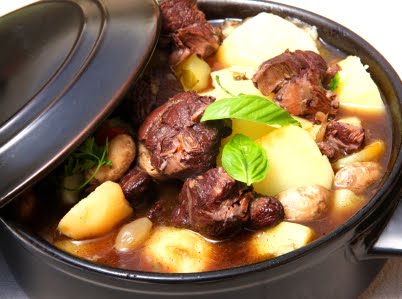
Hearty Winter Casseroles - Boeuf Bourgignon

August has just begun and at last we’re on the downhill run to Spring. But it is still winter, and August is the month when the old saying “as the days grow longer, the cold grows stronger” holds true. So, despite sunny days in Sydney that can reach 21C at midday, there are still chilly nights and gloomy grey days, (especially in Melbourne and Tasmania), and that means warming winter stews.

Stews and casseroles are interchangeable terms. Technically, a casserole is cooked in a casserole dish in the oven, while a stew simmers gently on the top of the stove. But really, they are interchangeable, the main point to remember is to cook slowly and gently. You can use a crockpot or slow cooker, a casserole or a stewpot, but DO NOT use a pressure cooker! Pressure cooking a stew results in tough meat and bland flavours and is a waste of good ingredients.

In an earlier post I wrote in praise of meat as a treat, not as something to be had every day. In that post, I talked about lamb – my favourite meat, and one of the world’s 100 healthiest foods.

So this time I’m focusing on beef – actually stewing steak and gravy beef, (sorry, I don’t know the equivalent US term). Australia is fortunate to have high quality meat that is relatively inexpensive, and stewing steak and the slightly fattier gravy beef are budget pleasing cuts. They are cheap, incredibly nourishing, and respond best to slow, gentle cooking, melting into tenderness and creating rich flavours with the other ingredients.

What’s so good about beef?

• High quality protein with all the essential amino acids in one package in relatively large amounts. One hundred grams of beef contains approximately 33 grams of protein.
• Iron, specifically haem iron, the easiest one to absorb. Iron is so essential for avoiding anaemia, and for enabling the blood's red cells to carry oxygen around the body. That 100 grams provides a hefty three to four milligrams of iron.
• Vitamins B1, B2, B6 and B12, zinc, selenium and phosphorus – good amounts of these essential vitamins and minerals.
• Tryptophan, the “feel good” food element. Tryptophan is an amino acid that works as a precursor to serotonin, the neurotransmitter that regulates sleep, appetite and mood. Foods rich in tryptophan are said to be “good mood foods”. Beef has tryptophan in spades – 100 grams contains about 0.33 grams.

So to the recipe: Boeuf Bourgignon

This is not the upmarket version that Guillaume Brahimi prepares, but a more budget conscious, down-to-earth casserole that’s probably nearer the French peasant original. As the name suggests, the meat was originally cooked in Burgundy. Since appellation contrôlée, we can no longer buy Burgundy in Australia, so choose a hearty red wine such as a cabernet-merlot or cabernet shiraz blend. Even a good cask wine will serve the purpose.
1kg (2 lb) stewing steak cut into 4cm (1½ inch) cubes
125 gm (4 oz) streaky bacon, cut into strips
1 carrot, sliced
1 onion, chopped
1 (or more) garlic clove smashed or chopped
1 teasp salt and ¼teasp ground black pepper
1 tablesp plain flour
500 ml (2 cups) red wine
250 ml (1 cup) beef stock (or chicken stock)
2 tablesp tomato puree
½ tsp thyme
1 bay leaf

16 small button onions or shallots peeled
60 gm (2 oz) butter
2 tablesp olive oil
375 gm (12 oz) button mushrooms

Put the flour with the salt and pepper into a large paper or plastic bag, and shake gently to mix. Drop in the beef cubes, a few at a time and shake to coat the meat with seasoned flour. Keep the bag firmly closed as you shake, you don’t want flour flying all over the kitchen and you!

If your casserole is safe to use on the stovetop, fry the bacon strips in it until the fat is rendered out and the pieces are crisp. Use a large frying pan if you can’t fry with the casserole. (The frying pan needs to be big enough to hold the meat, vegetables, stock and wine.) Take out the bacon, leaving the fat in the pan.

Add a big slurp of oil and heat until sizzling, throw in the meat cubes in batches so as not to crowd them, and brown all over. Set aside with the bacon. Now add the carrot and chopped onion and fry briefly.

Put the bacon and meat back into the casserole/frying pan, add the tomato puree, thyme, bay leaf and garlic, then pour in the red wine and stock. Bring the mixture to a rolling boil, stirring as it boils, and turn down to a low simmer. Allow it to simmer gently for five minutes to cook off all the alcohol, then transfer casserole to a preheated 160C (325F) oven. Cook for 3 to 4 hours.

Meanwhile, prepare the mushrooms and shallots. Heat up half the butter & olive oil in a small saucepan and sauté the onions or shallots for about 10 minutes until softened and brown. Set aside and repeat with rest of the butter and oil and the button mushrooms.

When the meat is tender, pour off as much of the liquid as you can from the casserole into a saucepan. Pop the cooked onions/shallots and mushrooms into the casserole, tucking them in around the meat. Bring the cooking juices to a boil, and simmer until reduced to about a third. Pour back into the casserole.

Serve with potatoes, either steamed or mashed and creamy, and steamed green vegetables.
Serves 4.

Another Beef Casserole in the next post!

Buon Appetito!

Wednesday, June 1, 2011

Stocking Up for Winter

With the colder weather upon us, at least in the southern hemisphere, it’s time to think about simple warming foods like soups and stews that use fresh ingredients complemented by what you’ve got stashed in your pantry and freezer.

As well as a recipe for chicken stock, I’m going to tell you a way to preserve garlic, a tasty mushroom spread, and the easiest way to keep fresh ginger fresh

Making Stock

As discussed in my previous post, good home-made stock is a great basis for just about any type of soup, and can also add a depth of flavour to stews, casseroles and gravy. Making stock takes time, but it’s pretty easy, and the results, as well as being full of minerals and flavour, are much cheaper than the ready-made stuff. You need to allow time for the stock to cook, and time to drain it, so it’s a good idea to start the night before. You also need a deep enough stockpot to take up to six litres of liquid, plus all your meat and vegetables. It’s best if it’s a heavy based one, but I’ve managed for several years with a cheap stainless steel pot that always feels too light, but does the job.

It's possible to make beef stock, but that involves a LOT more time and some very big bones, so I very seldom make it. Chicken stock is a great all-rounder. It's also possible to make a vegetable stock, but it isn't worth the effort - it doesn't keep well, and it's easy enough to make fresh each time.

Basic Chicken Stock

2 kilos (5 lbs) of chicken necks (very little meat) or chicken drumsticks (lots of meat)
large handful of salt,
3 or 4 bay leaves
8-10 black peppercorns
Celery leaves
3 large onions, skin on, cut in half
4 carrots chopped in quarters
3 or 4 garlic cloves, peeled
1 tablesp white wine or vinegar (helps to dissolve the minerals in the bones)
5 litres of cold water.

Put all the ingredients in your stockpot, bring to the boil and allow to boil vigorously for 10 minutes, then turn down and simmer for an hour. If using the chicken drumsticks, now is the time to pull them out and strip of all the meat, then throw the bones back in and simmer for another 45 minutes. The chicken necks can just be simmered for the whole time. Keep an eye on the pot that you don’t lose too much liquid from evaporation.

When the simmering is done, turn off and allow to cool slightly while you put together your draining set up. You need a large colander, balanced over a pot big enough to take the approximately 3½ litres of stock. Pour the contents of the stockpot careful into the colander, scooping all the solids in as well. Cover and leave for a couple of hours, overnight is good, for every drop of goodness to drip through.

Throw all the solids into your compost bin, put the stock back on the stove and bring to the boil. Let it boil vigorously for at least five minutes to sterilise it, then pack it while hot into freezer containers. Any fat in the stock will rise to the surface and solidify in the freezer, and can be scraped off before you use your delicious and nutritious stock.

Hint: Keep a bread bag in the freezer and every time you prepare vegetables for a dish, put the trimmings in the bag. (Don’t use potatoes or potato peelings, they make the stock taste muddy.) Tops and tails of carrots, the outer skin of onions, the coarse ends of celery, and in particular celery leaves, are all good, and provide the basic aromatics for your stock. When you buy a bunch of celery, cut the leaves off immediately to stop the plant transpiring and losing its crispness. The leaves add valuable minerals – calcium, magnesium, potassium and sodium – as well as flavour to your stock.

Keeping garlic in the freezer

Recently my local greengrocer had an over-supply of garlic and was offering 5 heads for $1. That’s way more garlic than I usually buy, especially in this rainy weather, when I’ve had garlic – the natural antibiotic – go mouldy! But I reasoned it should be possible to freeze garlic, and after a bit of Googling, I found several suggestions. Here’s my favourite. It takes a bit of chopping, but you have instant garlic.

Chop the garlic cloves roughly and put in the blender or food processor with some oil – about 1/3 cup to a cup of chopped garlic. This is vague I know, but it’s a matter of how much oil you think is just right. You don’t want it too runny but not too dry, as the oil helps prevent the garlic drying out. Whizz the mixture until it looks chopped enough for you. Decant into small airtight containers, label and freeze.

The neat thing about this method is that the mixture doesn’t freeze completely solid. It’s easy to scoop out as little or as much as you want without thawing the garlic. If you’re the sort of person who uses lots of garlic butter, simply replace the oil with butter. I would increase the proportion of butter to garlic, probably to 1:1. It’s all a matter of taste. Either way, you get all garlic’s health benefits – the antioxidants and polyphenols – especially allicin – that protect the heart and circulatory system and lower LDL cholesterol. To say nothing of it’s magnificent flavour!

Savoury mushroom spread

The same greengrocer had an abundance of white mushrooms, also very cheap, so I bought about 1 kilo (2lbs). As mushrooms are very light, you can imagine what a large lot that was. What I had in mind was a similar trick to preserving the garlic – some way to freeze the shrooms so they would be delicious when defrosted. I found this recipe in an old paperback on preserving. It was intended for wild fungi picked in the early morning from a dew-laden field, but it worked just as well for my cheap urban shrooms.

4 cups chopped mushrooms
1 cup chopped onion
At least 1 clove garlic, chopped fine or minced
1 tablesp olive oil
1 teasp soy sauce
1 teasp dried savory or rosemary
1/2 teasp dried thyme or oregano
1/4 teasp nutmeg
1/8 teasp black pepper
a few grinds of coarse sea salt

Sauté the onion and garlic gently in the oil. When the onion starts to soften, add the mushrooms and cook over low heat for about 5 minutes. Add the remaining ingredients and simmer about 10 more minutes over low heat.

Decant the hot mixture into small air-tight containers, label and freeze. This is good on toast, as a sauce for steak, chops, sausages – anything that would be improved with a dollop of mushrooms. It goes well in an omelette, and is handy for boosting the flavour of soups and casseroles.

Freezer-fresh ginger
Keeping ginger in the freezer is ridiculously easy. Simply cut the ginger rhizome into chunks about the size you would normally use. Leave the skin on, and wrap each chunk in cling wrap, then drop the chunks into a ziplock bag, or a handy bread bag. You can peel and grate or chop your ginger chunk while it's still frozen. (Don't defrost it - it goes soggy and uncooperative.)